Summary
Landfill biogas contains a highly variable mix of VOCs and other contaminants driven by waste decomposition stage, seasonal shifts, and legacy waste already in the landfill. As RNG (biomethane) from landfill production grows, operators are recognizing that traditional spot‑sampling methods are no longer sufficient to protect upgrading equipment or optimize carbon usage. Real‑time monitoring of multiple VOC components, especially lighter ketones that break through carbon first, enables earlier intervention, reduced downtime, and more efficient carbon management. Technologies such as the BioSpec VOC gas analyzer from Camlin Energy provide continuous, multi‑component measurement to safeguard plant performance and reduce operating costs.
Managing VOCs in landfill RNG
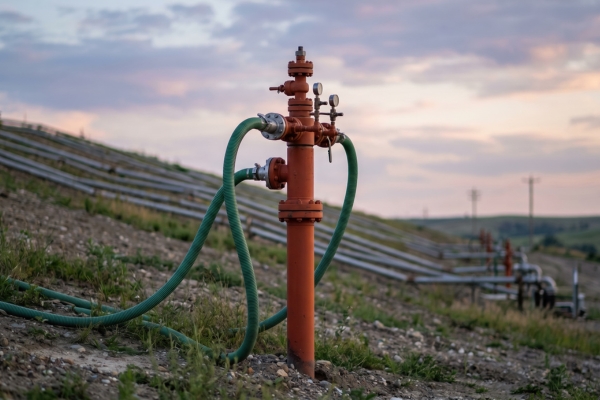
Landfill biogas contains a complex and highly unpredictable mixture of volatile organic compounds (VOCs), hydrogen sulfide, siloxanes, and other pollutants due to waste decomposition stage, high variability of waste across the landfill, and seasonal shifts. Historically, hydrogen sulfide and siloxanes have been the primary concerns due to their damaging impact on CHP engines in electricity‑generation applications. As the industry shifts toward higher‑value Renewable Natural Gas (RNG) production, effective management of the full spectrum of VOCs has become essential.
Activated carbon filters remain the most common method for VOC removal. However, to protect upgrading equipment and avoid costly reductions in output, operators must identify carbon saturation at the right moment – not too early, and certainly not too late.
Impact of VOCs on RNG upgrading systems
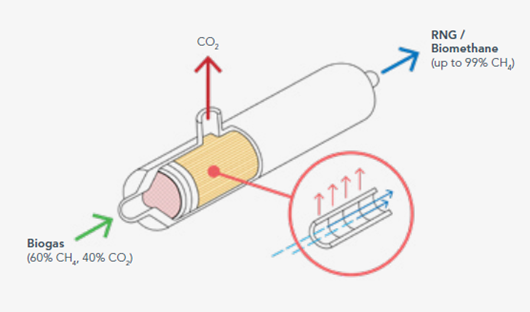
VOCs can cause significant damage to downstream equipment and result in gas not meeting pipeline specifications. Membrane upgrading systems are widely used in RNG production because they offer high efficiency, modular design, and reliable long-term performance.
VOCs can interfere with this performance if they reach the membranes in elevated concentrations. Managing VOCs upstream helps maintain expected throughput, preserve CO₂ removal efficiency, and extend membrane life. It also reduces the likelihood of unplanned maintenance and keeps overall plant availability high.
Some VOCs, such as terpenes like limonene and pinenes, can also mask pipeline odorant, adding a safety dimension to effective VOC monitoring.
Why spot sampling with colorimetric tubes can miss carbon breakthrough
Manual spot sampling with colorimetric gas detection tubes has traditionally been used to determine when carbon filters have saturated. These tubes are often sensitive only to heavier aromatic compounds such as benzene, toluene, and xylenes.
This approach has several critical limitations:
- Different VOCs break through carbon at different times. Lighter ketones, such as acetone and 2‑butanone, break through significantly earlier than heavier aromatics. Relying on tubes that detect only heavier compounds means breakthrough is detected too late, after damage may already have occurred.
- Spot checks provide only snapshots. Without continuous data, operators risk missing the exact moment of breakthrough unless they perform very frequent sampling, which increases labor and operational costs.
- No historical or trend information. Operators cannot see how VOC loading changes over time or correlate events with plant performance.
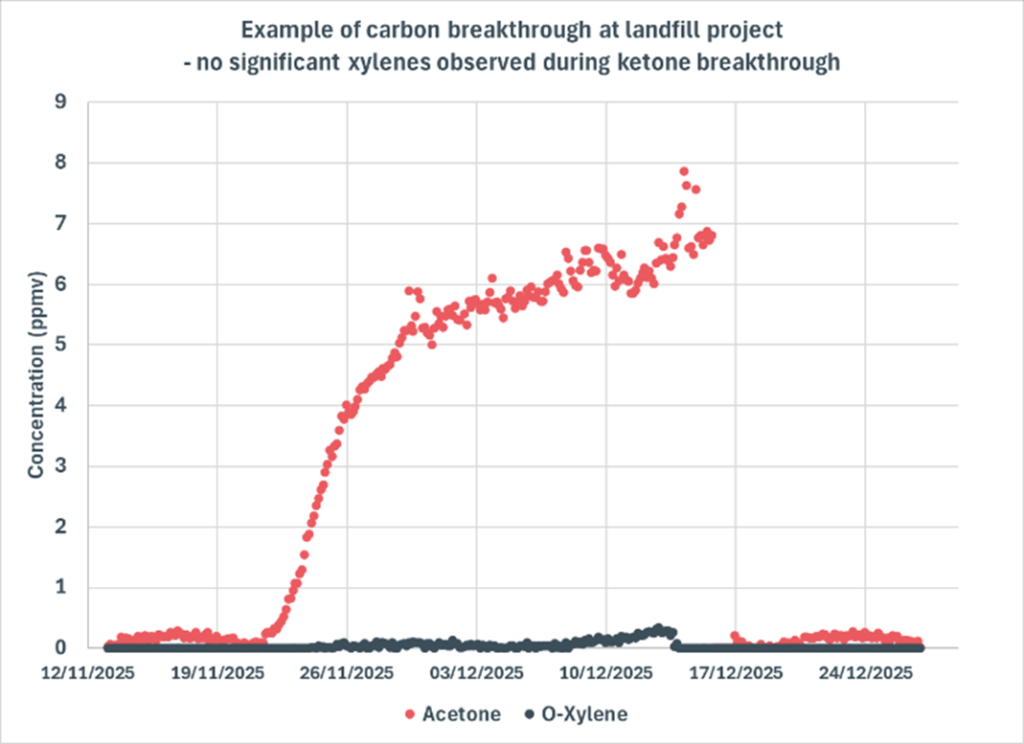
These limitations are becoming increasingly costly for RNG plants. Figure 2 illustrates the problem clearly, with lighter ketones breaking through the carbon bed with no xylenes breaking through. As such, carbon breakthrough would not be detected with xylene colorimetric tubes that are commonly used in the industry and acetone breakthrough could go undetected and potentially damage the downstream upgrading plant.
Advantages of monitoring multiple VOC components
Over the past five years, real‑time VOC monitoring has grown as RNG operators recognize the operational and financial risks posed by VOCs. Gas analyzers capable of measuring multiple components simultaneously, especially lighter VOCs, provide a more accurate and proactive view of carbon filter performance.
Key advantages include:
- Earlier detection of carbon breakthrough, driven by monitoring lighter VOCs that saturate carbon first.
- Improved protection of upgrading equipment, particularly membrane systems that are highly sensitive to VOC contamination.
- Optimized carbon usage, enabling operators to compare carbon types, extend filter life, and reduce spend.
- Data‑driven operations, with continuous trends rather than intermittent snapshots.
BioSpec VOC: Real-time multi-component VOC monitoring
Landfill gas is one of the most variable feedstocks in the biogas upgrading industry and VOCs can cause unexpected problems and significant costs if not carefully managed. The BioSpec VOC gas analyzer from Camlin Energy uses ultraviolet optical spectroscopy to measure a wide range of VOCs and other contaminants in biogas. By identifying the exact moment when activated carbon begins to break through, operators can better manage VOCs at site, intervene proactively and protect downstream assets.
Key capabilities include:
- Measurement of individual VOC species, enabling differentiation between compounds most harmful to upgrading equipment.
- Detection of lighter VOCs, which provide the earliest indication of carbon saturation.
- Monitoring of additional contaminants, including hydrogen sulfide, ammonia, benzene, and toluene.
- Fully optical operation, with no gas consumables and no need for recalibration.
- Multi‑point sampling, allowing a single system to monitor multiple locations across the plant.
This combination of breadth, accuracy, and low maintenance makes continuous VOC monitoring both practical and cost‑effective for RNG facilities, especially landfill and food waste projects where VOCs are particularly problematic.